
Rapid deployments of risk frameworks at scale
RDC.AI Risk Rating gives banks a single, highly governed environment for building, executing and monitoring regulated commercial risk rating models. Instead of fragmented model lifecycles spread across spreadsheets, vendor tools and one-off deployments, your risk frameworks live in one place with full versioning, continuous monitoring and an explanation attached to every rating. Ratings are published to downstream systems through an API and an MCP server, so your lending platforms, dashboards and AI agents all consume the same governed result.
Solution Highlights
more.
The problem with fragmented model lifecycles
Most banks do not have one risk rating process. They have several. A model built in one team, calibrated in a spreadsheet, deployed into a lending platform by a different team, monitored manually, and documented after the fact for the regulator. Each fragment adds cost, and each handoff adds risk.
The consequences compound. Two systems disagree about the same customer's rating. Nobody can say with confidence which model version produced a decision eighteen months ago. Recalibration takes a quarter. Model risk management becomes an archaeology exercise rather than a control.


What Risk Rating does
Risk Rating provides a consolidated and highly governed environment for execution of regulated risk modeling frameworks.
It covers the full lifecycle in one platform: building and containerizing the model, executing predictions, running the decision strategy, monitoring outcomes, and distributing the governed result to every system that needs it. Because it is built on the RDC.AI Genesis, everything is versioned and every rating carries a Self-Describing Decision.
Solution Value
Key Benefits

Automation
Automate risk rating and model execution using RDC.AI's Prediction Execution Services. Overlay models with rating scales and other treatment via RDC.AI's no-code decision workbench interface.

Explainability & Compliance
Every score is saved as a Self-Describing Decision, a comprehensive record of all inputs and model logic. Using RDC.AI's agentic capability, bankers can instantly explain the specific reasoning behind any rating.

Monitoring
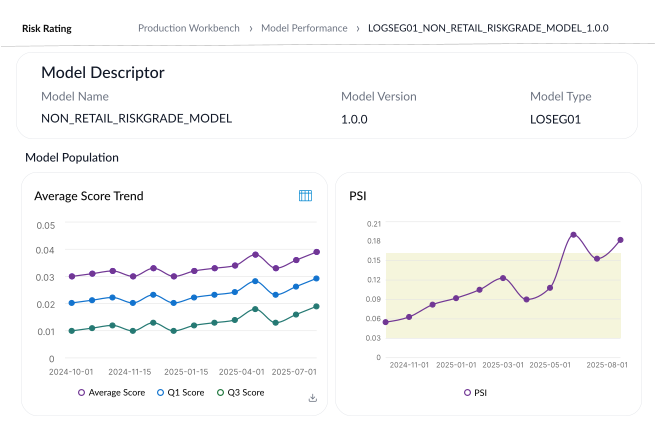
Pre-configured dashboards monitor model and decision performance in real time, giving credit risk practitioners the confidence to adjust settings whenever outcomes trend outside of risk tolerance.

Portability
Model and decision outcomes are exposed via the Decision API or MCP interface supporting a federated approach to score consumption.
Frequently Asked Questions
Does Risk Rating expose an API or MCP server?
Yes. Risk Rating publishes ratings and decision outcomes through an API for consumption by lending platforms, data warehouses, dashboards and reporting systems. It also exposes a Model Context Protocol (MCP) server, so AI agents can query decision outcomes, ratings and the associated insights directly, in a structured and traceable format.
Can we bring our own models?
Yes. Models are packaged as versioned containers within the platform, so frameworks your teams have built and validated can be executed and governed alongside RDC.AI models.
How is a rating explained?
Glass Box AI generates a Self-Describing Decision for every rating: a controlled-language explanation of the data used, the prediction made, the strategy applied and the evidence supporting the outcome, traceable end to end.
How does Risk Rating support model risk management?
Through comprehensive versioning across data, models, decision strategies and outcomes, continuous monitoring against defined thresholds, and a Self-Describing Decision attached to every rating. Limitations are disclosed and escalation pathways defined in advance.