
Product launch
Introducing RDC.AI Cowork
Your bankers and your AI, working the portfolio together.
In brief
- Ask in plain English, and RDC.AI Cowork runs the analysis on your customers, facilities and transactions, using your bank's own knowledge and skills.
- It works with the RDC.AI decision platform: business leaders set the direction, operations review and adjust the decision strategies, and the frontline gets decisions explained and actions recommended.
- Skills, knowledge and tools are shared across the bank, so everyone works from the same house answer.
- Agents follow a governed process of design, testing, deployment and monitoring, with logging, usage analytics and evaluation along the way.
- An agent can only see what the user is entitled to see. Permissions sit on the data itself, so no agent or prompt can get past them.
Today we're launching RDC.AI Cowork, an AI workspace for commercial banking. You ask questions in plain English, and it does the analytical work on your customers, facilities and transactions, using your bank's own knowledge and skills.
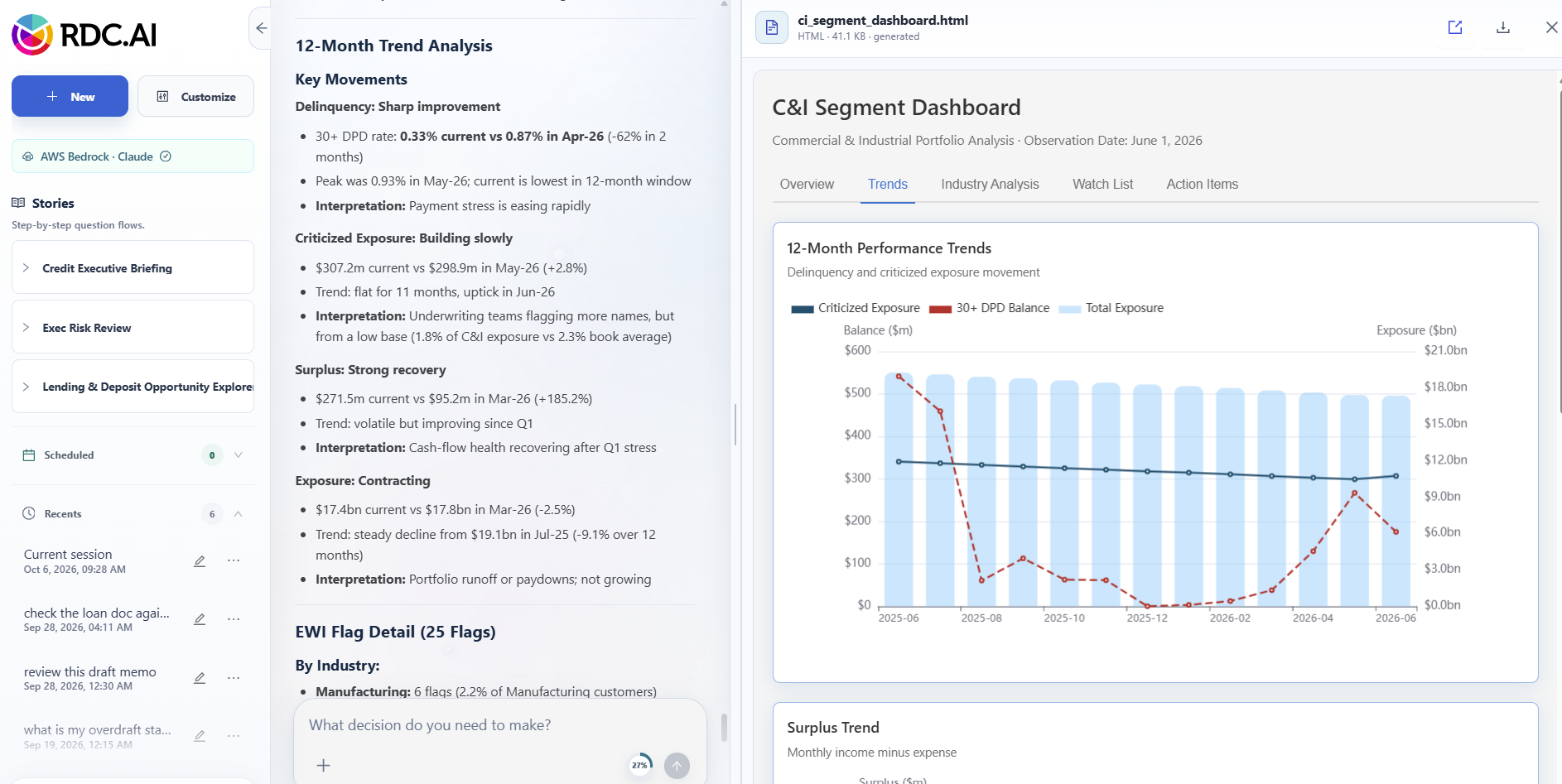
A credit executive might start the morning by asking RDC.AI Cowork for a summary of the book. If the criticized rate in one segment has crept up, they can ask what's behind it and get the list of customers driving the movement, then open one of those customers to see cash flow and exposure in more detail. All of that happens in one conversation, with no report request and no waiting for someone to pull the numbers.
We built RDC.AI Cowork because the general-purpose AI assistants many banks now use can't see the bank's portfolio, its credit policy or its decision strategies. Those assistants make each banker faster, but they each end up working from their own prompts, sources and definitions. RDC.AI Cowork is connected to the portfolio, the policy and the decision platform, which gives the whole bank the same basis to work from, and each agent in it is governed the way a bank already governs a model.
Plain-English questions on your customers, facilities and transactions
There's no query language or list of commands to learn. You ask the way you'd ask an experienced analyst, and RDC.AI Cowork runs the analysis: it pulls the data, does the calculations and comparisons the question needs, and comes back with a written answer, a table, a chart or an interactive report. Follow-ups keep their context, so a request like "drill into this segment" works without repeating yourself.
Things credit teams ask
- Give me a summary of the portfolio
- Drill into Commercial Real Estate
- Compare this customer to their peer cohort
- Is this customer's expense pattern seasonal, or a warning sign?
- How would a 10% rise in expenses next quarter affect this borrower's ability to repay?
RDC.AI Cowork can also test the impact of an external event on your portfolio. Ask about a food contamination outbreak, for example, and it maps the event to the affected industries in your portfolio, then reports your exposure to those industries along with any risk signals already showing.
The answers come from your data and follow your bank's knowledge and skills. Once your credit policy, your definitions and the way you answer each type of question are set up in RDC.AI Cowork, its answers read the way your own credit team would write them.
Analysis you run often can be saved as a Story, a sequence of questions that runs with one click. The Credit Executive Briefing Story, for example, brings the portfolio view and the latest early warning activity together into a pack you can take straight to a credit committee.
Connected to the decision platform
Because RDC.AI Cowork is connected to RDC.AI's decision platform, the work carries on past the answer and into the decision itself, something a general assistant has no access to. It works across the whole bank, with a different job at each level:
- Business leaders set the direction. They see the portfolio, find what's moving it, and go straight down to the customers behind the movement.
- Operations review and adjust the decision strategies. They look at how a strategy is performing, have it explained, run what-if scenarios and change it where it needs to change.
- The frontline gets decisions explained and actions recommended. A relationship manager sees why a decision came out the way it did, and the action RDC.AI Cowork recommends next for that customer.
Example
Say early warning alerts in your transport book have doubled this quarter. Where a general assistant could only explain what an early warning indicator is, RDC.AI Cowork works from your actual alerts.
The business leader sees the rise, which segments it's coming from and the customers behind it, and decides whether it's real stress or noise worth tuning out.
Operations open the early warning strategy. RDC.AI Cowork explains which rules are firing and why, and supports further analysis and what-if scenarios. When the strategy needs to change, operations adjust it.
The relationship manager opens a flagged customer and sees why it was flagged: falling inflows, supplier payments running late and a balance trending down. They can ask follow-up questions about the customer and how it compares with its peers, and RDC.AI Cowork then recommends what to do next, following your early warning procedures and job guides, tailored to this customer.
This is RDC.AI's Decision Intelligence Cycle of design, execution and monitoring. It draws on the decisioning work behind Decision Workbench and Prediction Workbench, which banks already use for their credit strategies and models. The loop closes inside one system, with each step on the same audit trail, so when someone asks why a strategy changed, the record goes back to the question that started it.
Shared skills, knowledge and tools
Ask a credit associate and a second-line analyst the same question about two similar customers today and you may get two different answers, because each brings their own assumptions and sources. Giving each of them a general AI assistant makes them faster, but they still head in different directions.
For a bank, that matters. Two customers who are alike in the ways that count should get the same treatment, and that's what a regulator will test. That kind of consistency comes from shared inputs, whatever model sits underneath.
RDC.AI Cowork shares three things across business leaders, operations and the frontline:
- Skills. A skill is a short written instruction, in business language, that tells RDC.AI Cowork how to handle a type of request, such as what your bank means by an early warning or what belongs in a risk summary. Shared skills are written by operations under direction from business leaders, and the frontline works from them.
- Knowledge. Your credit policy and procedures, under governance. A document only goes live once someone publishes it, and each answer cites the clause it relied on.
- Tools. Agents get their figures through the same tools, so a measure is worked out the same way whoever asks for it.
Together, these make up what we call the house answer: the version of a definition, policy or figure that the whole bank works from.
Each user also works in a profile that matches their role. A credit executive's profile answers at portfolio level, while a relationship manager's goes down to the individual customer, and profiles can lean toward a risk, growth or profit view.
What stays the same between two answers is the content. Two answers to the same question use the same figures, logic, policy clause and skill. The form can differ: a different profile might get a different chart, a different order or more detail, but the figures underneath come from the same calculations whoever asks.
A governed process for agents
Banks already know how to govern a model, and RDC.AI Cowork governs agents the same way, through design, testing, deployment and monitoring. Each agent, along with the skills and knowledge it relies on, is versioned, can be checked before it's used, and is monitored once it is.
Monitoring an agent depends on being able to see what it did, and RDC.AI Cowork gives you three views of that.
Logging. While RDC.AI Cowork works, the Execution Panel shows the steps it's taking, the tools it's calling and the skills it has applied. Each figure in the finished answer links to the data request that produced it, so when someone on the credit committee asks where a number came from, you can show them. Reviewers get read-only transcripts of each session, including the reasoning, and auditors get a log of each data access, kept with the conversation.
Usage analytics. A built-in dashboard shows how RDC.AI Cowork is being used: who is using it, which skills people rely on most, which skills nobody uses, and which questions it couldn't find the knowledge to answer. The last of these is a good guide to what to write next.
Evaluation. When a conversation ends, RDC.AI Cowork reviews it automatically. A set of evaluators check its work, and each returns a score with a short written explanation, so your team knows what went wrong and who should fix it.
Together, these answer the question a model risk review will ask months after the event: how a specific answer was produced, and whether what produced it had been approved.
Agents only see what the user can see
Permissions are set per user and enforced on the data, underneath the AI. An agent works on behalf of the user who asked, so it can see exactly what that user is entitled to see and nothing more.
Agents can only reach data through governed tools. There are no free-form queries, and the model never touches the database, so however a question is worded, it can't get anyone into records they aren't entitled to see.
Why it matters
For business leaders
Direction set once and carried through to each banker, with the same figures and policy basis whoever is asking.
For operations
Decision strategies reviewed, tested with what-if scenarios and adjusted in plain English, with the change and its reasons on one record.
For the frontline
Fewer report requests and a clear explanation of each decision with a recommended next action, leaving more time for customers.
For risk and compliance
Agents governed the way models are, with answers that can be reconstructed long after the conversation has ended.